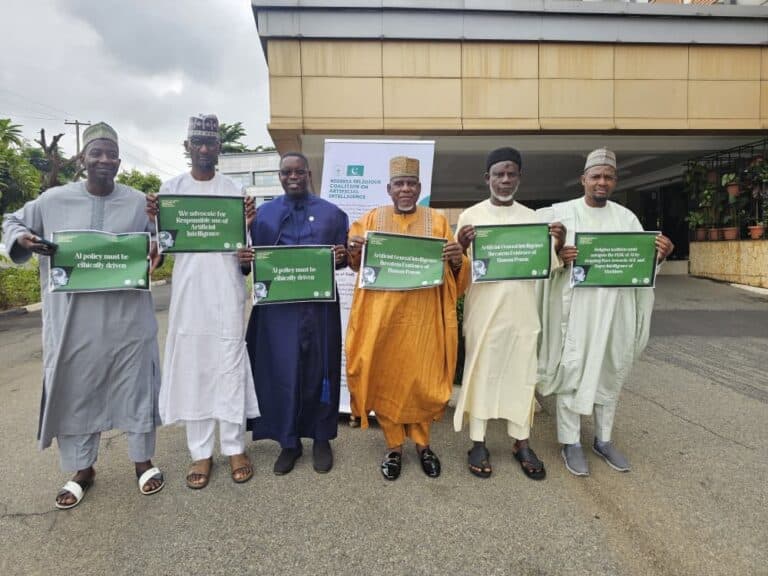
By Justina Auta Religious leaders in Nigeria have called for the inclusion of faith-based perspectives in the development of national policies on Artificial Intelligence (AI), warning that unchecked adoption of the technology could undermine cultural, moral and spiritual values. The call was made on Tuesday in Abuja at a meetingContinue Reading
By Justina Auta
Religious leaders in Nigeria have called for the inclusion of faith-based perspectives in the development of national policies on Artificial Intelligence (AI), warning that unchecked adoption of the technology could undermine cultural, moral and spiritual values.
The call was made on Tuesday in Abuja at a meeting organised by the Christian Council of Nigeria (CCN) and Jama’atu Nasril Islam (JNI).
The meeting was facilitated by the CCN-Institute of Church and Society (CCN-ICS), Ibadan, with support from the Future of Life Institute, United States.
Speaking at the event, the Director of CCN-ICS, Rev. Kolade Fadahunsi, said that although AI offers immense benefits, it should remain a “derivative intelligence” and must not be allowed to override human reasoning and divine principles.
Fadahunsi said the misuse of AI could erode ethical standards, weaken spiritual consciousness and distort cultural identity.
According to him, religious values, cultural heritage and human empathy must be deliberately incorporated into AI governance frameworks to ensure that technology serves humanity rather than replaces it.
He called for stronger ethical oversight in Nigeria’s Artificial Intelligence Strategy (NAIS), urging policymakers to ensure the participation of religious institutions in the development of national AI frameworks.
The cleric stressed the need to examine the strategy, particularly its fourth pillar being developed in collaboration with the National Information Technology Development Agency (NITDA), from an ethical standpoint.
He said the AI policy should reflect Nigeria’s religious diversity and moral foundations, adding that the exclusion of faith-based voices would leave the framework incomplete.
Fadahunsi said that the country’s major religions, Islam and Christianity, should be adequately represented in the process of translating the strategy into policy.
He said such representation would enable religious leaders to provide moral guidance and help address potential challenges arising from the deployment of AI technologies.
Also speaking, the Secretary-General of JNI and Chief Imam of the National Mosque, Abuja, Prof. Khalid Aliyu-Abubakar, said AI, in spite of its benefits, poses risks to humanity, empathy and religious ethics if not properly regulated.
Aliyu-Abubakar said religious institutions remained custodians of cultural values, morality and ethical standards and should therefore be involved in shaping AI policies.
He urged government and policymakers to integrate religious and cultural considerations into AI governance frameworks to prevent the erosion of inherited values.
Similarly, an Administrative Officer at JNI headquarters, Yusuf Saidu, said religious leaders must be fully involved in AI policy development to safeguard long-standing moral and cultural values.
Also, the Chief Imam of Uthman Bin Affan Mosque, Abuja, Dr Umar Yanda-Aliyu, called for early engagement of religious institutions in AI policymaking rather than involving them only after challenges arise.
In his remarks, an AI Safety Engineer, Faruna Godwin, advocated the development of AI systems that reflect societal and religious ethics, warning against deploying technologies that conflict with shared moral values.
Godwin expressed concern over the limited representation of local languages and cultural realities in many AI systems, warning that the gap could result in “digital colonisation” if not addressed.
He urged lawmakers to intensify deliberations on AI regulation, stressing that ethical and religious considerations should guide policy decisions to promote responsible innovation and protect national values. (NAN)(www.nannews.ng)
Edited by Funmilayo Adeyemi